
A rotten egg smell in well water comes from hydrogen sulfide gas, and orange or black stains come from iron and manganese. For most Shenandoah Valley wells, an oxidizing iron filter fixes all three at moderate levels, a carbon filter handles only a faint smell, and a smell that shows up in hot water only usually points to the water heater, not the well.
Which one you need depends on three things: what is in the water, how much of it there is, and where the smell or stain shows up. This guide walks through each one so you know what to ask for before anyone quotes you a system.
What Causes the Smell and the Stains
Valley wells draw from limestone and other rock that adds minerals to the water. A few of those cause most of the calls we get about smell and staining.
- Hydrogen sulfide. A gas dissolved in the water. Virginia Cooperative Extension says it gives water a sulfur or "rotten egg" smell and taste, which may be especially noticeable in hot water. Most people can smell it at 0.5 to 1.0 milligrams per liter (mg/L).
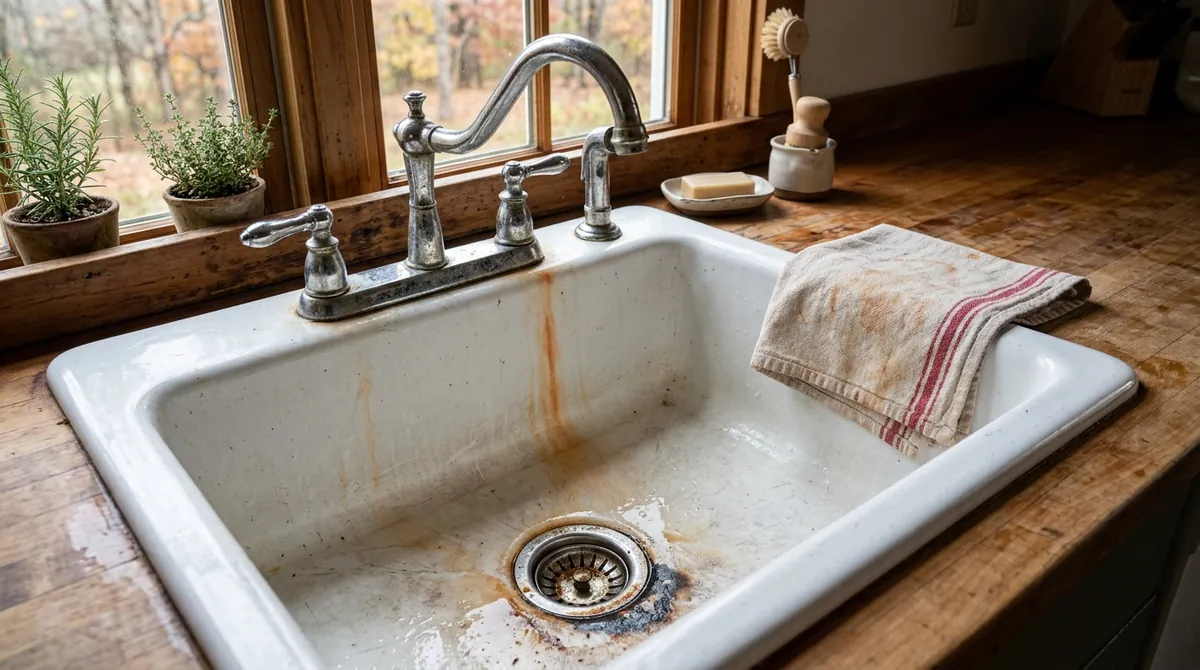
- Iron. Water that is clear from the tap can still carry dissolved iron. It turns to rust when it meets air, which leaves reddish-brown stains on sinks, tubs, dishes and laundry.
- Manganese. Similar to iron, but the stains are brownish-black. It often shows up as dark spots in the toilet tank or grey streaks on white laundry.
- Sulfur and iron bacteria. These live in low-oxygen places such as wells, pipes, softeners and water heaters. They can produce the smell or a slimy orange or black film in the toilet tank.
The U.S. Environmental Protection Agency sets secondary standards of 0.3 mg/L for iron and 0.05 mg/L for manganese. These are guidelines for taste, color and staining, not health limits.
First, Check Where the Smell Shows Up
Before you pick a filter, run two glasses of water at the kitchen sink: one cold, one hot. Smell each one away from the sink.
Smell in both hot and cold water. The hydrogen sulfide is coming from the well or the groundwater. That calls for treatment at the point where water enters the house.
Smell in hot water only. The cause is usually inside the water heater. Virginia Cooperative Extension explains that sulfate in the water can be changed into hydrogen sulfide by a reaction with the heater's magnesium rod, the metal rod that protects the tank from rust. Bacteria in a warm tank can do the same. In that case a whole-house filter may not be needed at all. A different rod, a tank flush or treating the tank can often fix it. Our guide to water heater repair or replacement covers the tank side.
Smell that comes and goes, or only after the water sits. Bacteria in the well or plumbing are a common cause. Shock chlorination of the well can clear it, and then the water is tested again.
Smell only from one tap or one fixture. Look at that fixture's drain before you treat the water. A dry trap or a dirty drain can smell like sulfur too.
Which Filter Fixes Which Problem
There is no one filter for every well. These are the main options and where each one fits.
Activated Carbon Filter
A carbon filter can remove a trace of hydrogen sulfide, up to a few tenths of a milligram per liter. It is a fit for a faint smell with no iron. Above that, the carbon fills up fast and the smell returns. The cartridge needs replacing on a schedule, so it is a running cost.
Oxidizing Iron Filter
This is the most common fix for Valley wells that have smell and stains together. The filter turns dissolved iron, manganese and hydrogen sulfide into solid particles it can trap, then backwashes them down the drain on a set schedule.
Virginia Cooperative Extension says an oxidizing filter works at combined iron and manganese levels of up to 15 mg/L, and at hydrogen sulfide levels up to about 6 mg/L. Many current systems use air injection: a pocket of air at the top of the tank does the oxidizing, so there are no chemicals to add. Others use a manganese greensand media that is regenerated with potassium permanganate.
Water Softener
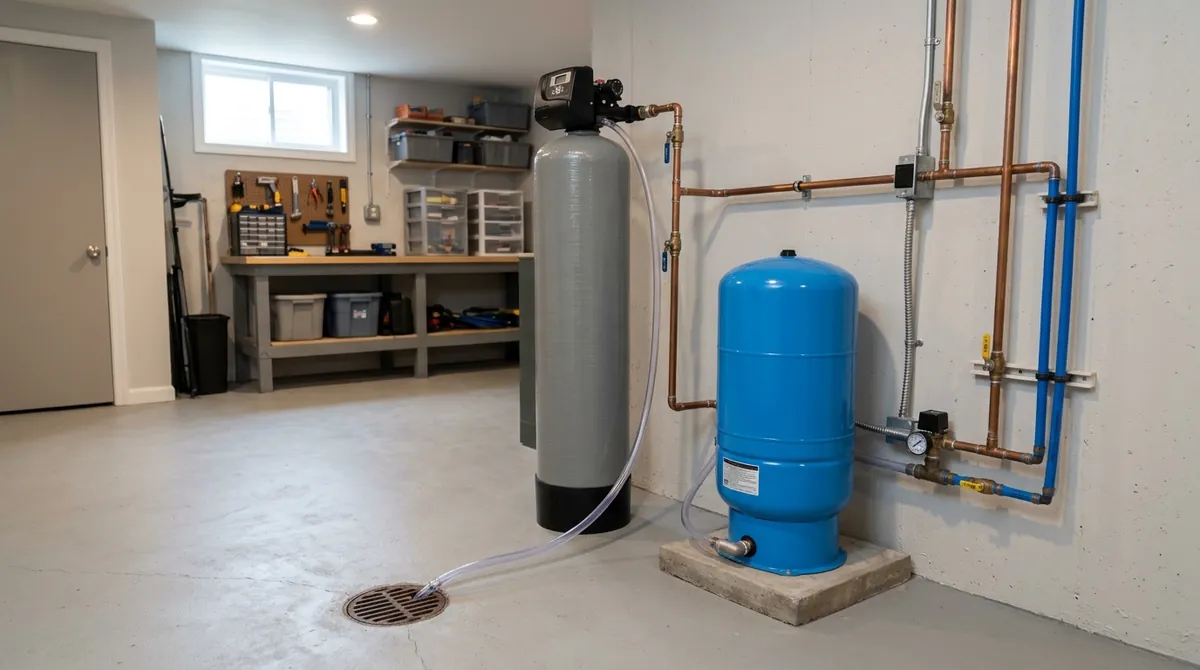
A softener can remove some iron as it removes hardness. Virginia Cooperative Extension puts the limit at combined iron and manganese of 5 mg/L or less, and says to check the maker's maximum for the model. A softener does not remove hydrogen sulfide, and heavy iron can foul the resin over time. On many Valley wells the softener goes after an iron filter, not in place of one. Our water softener installation page explains how we size one.
Chlorine Injection and a Filter
For very high levels, above about 6 mg/L of hydrogen sulfide or over 10 mg/L of iron and manganese combined, a small pump feeds chlorine or another oxidizer into the water, and a filter after it removes the solids. This is less common in homes, and it needs more upkeep.
Iron Filter or Softener: How to Tell What You Need
Most stained-sink calls come down to this question. Here is a quick way to think about it:
- Orange stains, no smell, low iron, hard water. A softener rated for that iron level may handle both, if the test supports it.
- Orange or black stains plus a rotten egg smell. An iron filter first, then a softener if the water is also hard.
- Smell only, no stains. Carbon for a faint smell, an iron filter for a strong one. Check hot water first, as above.
- Slime in the toilet tank or a smell that comes and goes. Treat the bacteria first with shock chlorination, then retest before buying equipment.
Order matters when there is more than one stage. A sediment filter usually goes first, then the iron filter, then a softener, with UV last if bacteria are a concern. Our guide to choosing a well water treatment system explains that order in full.

Test Before You Buy a Filter
The right filter depends on numbers: how much iron, how much manganese, how hard the water is, its pH, and whether the smell is in the well or the heater. A filter sized without them is a guess, and a wrong guess is expensive. An iron filter that is too small lets stains through, and a softener asked to do an iron filter's job wears out early.
We start every well water visit with a free basic water test at your tap. You see the results while we are there, and we explain what they mean before we suggest anything. It is not a lab-certified test. For bacteria and health questions such as lead, use a certified lab or the Virginia Household Water Quality Program's well water clinics run by Virginia Cooperative Extension, and bring us those results. Our free in-home water testing page explains what the visit covers.
Questions to Ask Before You Choose a System
- What are my iron, manganese and hardness levels, in numbers?
- Is the smell in the cold water, or only the hot?
- Could bacteria be part of the problem, and should I shock chlorinate first?
- What media does the iron filter use, and how often does it backwash?
- Does the system need chemicals, or is it air injection?
- Do I need a softener after the iron filter, or not?
- What upkeep does it need each year, and what does that cost?
A good installer answers each one before you sign.
How We Handle Smell and Stain Calls
- Call us. Monday to Friday, 8am to 5pm. Tell us what you see and smell, and whether it is in hot water, cold water or both.
- Free basic water test. We test at your tap and look at the well equipment, the pressure tank and the water heater.
- Explain the cause. We tell you what we found and which option fits, and we explain before we change anything.
- Quote, then install. You get a quote before any work starts. Most water treatment installs are done in one visit.
- Walk-through. We show you how the system works and how often it backwashes or needs service.
See our well water treatment page for the full service, or UV water purification if bacteria are part of the picture.
Sulfur Smell or Iron Stains in Rockingham County?
Pure Water Pure Air treats well water in Linville, Broadway, Timberville, Harrisonburg and across the Shenandoah Valley, from our family-owned shop in Linville. Test your water first, and we will explain what it needs.
Call (540) 830-7963. We are open Monday to Friday, 8am to 5pm. Leave a message after hours and we will call you back. Virginia contractor license 2710018903.