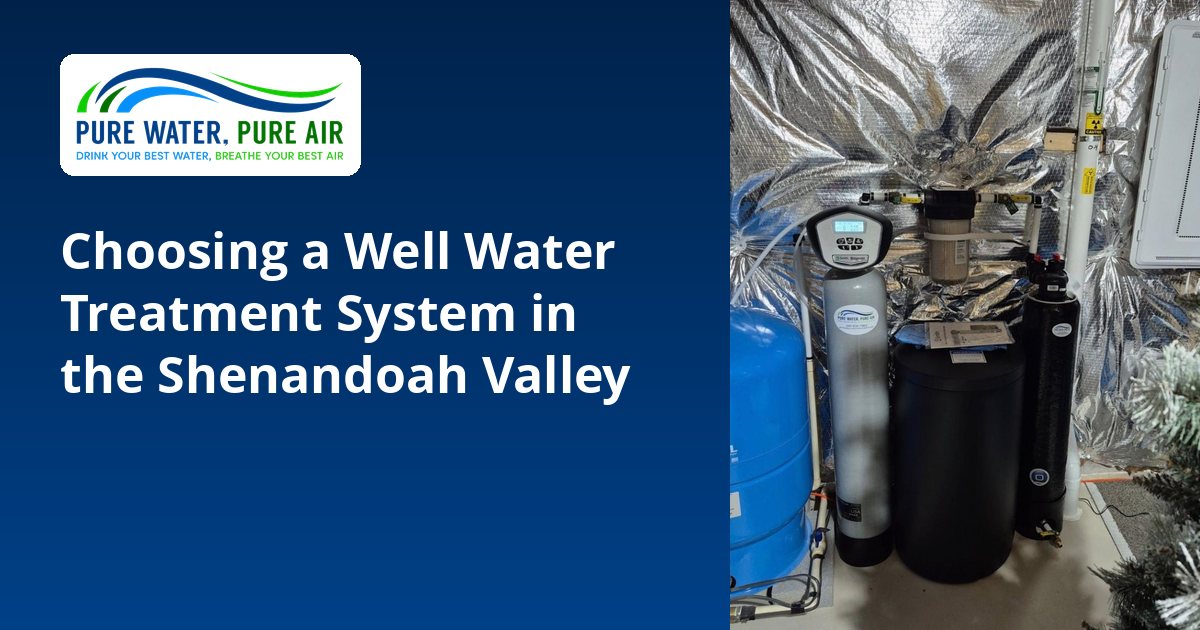
The right well water treatment system in the Shenandoah Valley starts with a water test. Valley wells often carry hardness, iron, manganese, sulfur or low pH. Each problem needs its own fix, such as a softener, an iron filter or an acid neutralizer. The stages then go in a set order, with UV last.
Why Valley Wells Need Their Own Plan
If you live on a well in the Valley, you are far from alone. About half of Rockingham County residents rely on private wells, according to Virginia Cooperative Extension. Out in the farm country around Linville, Edom and Singers Glen, rural homes very often use wells.
A private well is your own water system. No utility treats it before it reaches your tap. That means the job of testing and treating it falls to you.
Limestone Under Your Feet
The Valley sits on limestone karst. Karst is rock with cracks, sinkholes and caves that water moves through quickly. You can see it in show caves like Grand Caverns near Grottoes, Endless Caverns near New Market and Shenandoah Caverns near Mount Jackson.
That rock shapes your water in two ways. First, Valley wells mostly draw from limestone and other carbonate rock, which tends to make water hard. Second, water can move through karst fast. Virginia Cooperative Extension notes that well contamination can come from as close as your yard or a neighbor's. It can also come from 5 to 10 miles away.
What Studies Have Found
A Virginia Tech study of Rockingham County well water looked at what turns up in local wells. The main problems were:
- Iron and manganese
- Hardness
- Dissolved solids
- Bacteria
No two wells are the same, though. Your neighbor's test does not tell you what is in yours. That is why every good plan starts with your own water.
Matching the Problem to the Equipment
Most well problems show up as something you can see, smell or taste. Here is how common signs line up with the equipment that treats them.
| What you notice | Common fix |
|---|---|
| Orange-brown stains | Iron filter |
| Black specks or stains | Iron filter |
| Rotten egg smell | Sulfur filter |
| Blue-green stains | Acid neutralizer |
| Sand or grit | Sediment filter |
Water Softener
Hard water leaves scale, a hard, chalky mineral crust, on faucets and inside pipes. Soap does not lather well. A softener swaps out the minerals that cause hardness. Scale also shortens water heater life and clogs tankless heaters, so softening protects those too. See our water softener installation services for more.
Iron and Sulfur Filter
Iron leaves orange-brown stains in sinks, tubs and laundry. Manganese leaves black stains. Sulfur makes water smell like rotten eggs. An iron filter, often an air-injection type, turns these into solids it can trap. Then it flushes them out on a set schedule. One filter can often handle iron, manganese and sulfur together.
Acid Neutralizer
Water with low pH is acidic. It can eat away at copper pipes and leave blue-green stains on fixtures. An acid neutralizer runs water through a mineral bed that raises the pH. That helps protect your pipes and the equipment after it. The mineral bed wears down as it works, so it needs to be topped up from time to time.
Sediment Filter
Sand, silt and grit can come up with well water. A sediment filter catches them before they reach the rest of your system. That helps every stage after it work the way it should. Some sediment filters use cartridges you swap out. Others flush themselves clean. Grit often shows up after heavy rain or work on the well.
UV System
UV light treats bacteria such as coliform. It does not remove hardness, iron or chemicals. It also needs clear water to work, so it goes after the other filters. Learn more on our UV water purification services page.
Putting the Stages in the Right Order
Many Valley wells have more than one problem. A well might carry iron, hardness and low pH all at once. Then you need more than one stage, and the order matters.
A Common Order for a Staged System
Every home is different, but a common order looks like this:
- Sediment filter to catch sand and grit first.
- Acid neutralizer to raise the pH if your water is acidic.
- Iron and sulfur filter to take out iron, manganese and the egg smell.
- Water softener to remove hardness.
- UV system last, to treat bacteria in clear water.
Why the Order Matters
Each stage protects the one after it. Sediment can clog an iron filter, so it comes out first. Iron can foul a softener, so the iron filter goes ahead of it.
UV comes last for a reason. Stains, cloudiness and minerals can shade bacteria from the light. Clear water lets the UV do its job.
Not Every Home Needs Every Stage
Not every home needs every stage. Some wells only need a softener. Others need a full set. Adding a stage you do not need only adds cost and upkeep. Leaving out one you do need can let a problem slip through. The test tells you which stages you need and which you can skip.
Space and Setup
A staged system takes room. Most go near the well pressure tank in a basement, a garage or a crawlspace. Each stage may need a drain line for its cleaning cycle. Many need power as well. We plan the layout around your space before we quote.
Test Your Well Water First
Buying equipment before you test is like buying a key before you see the lock. A test shows what is in your water, and how much. Then you can match each problem to the right fix.
Our Free Basic In-Home Test
Our team comes to your home and runs a free basic water test on site. You see the results while we are there. Then we explain what they mean and what your options are.
This test covers the everyday problems that shape a treatment plan. It is not lab-certified. Lab tests are not part of this visit. Our free in-home water testing page explains what the visit covers.
When You Need a Certified Lab
Some questions need a certified lab. These include bacteria, lead and other health tests. For those, use a certified lab or the Virginia Household Water Quality Program.
The Virginia Household Water Quality Program is run by Virginia Cooperative Extension. It holds low-cost well water clinics. It is an honest option for lab results, and you can bring those results to us.
How Often to Test
Wells can change over time. Consider a new test if:
- The taste, smell or color of your water changes
- You see new stains in sinks or tubs
- Your area has had heavy rain or flooding
- You are buying or selling a home with a well
A test after a change gives you a clear picture before you spend money.
What Shapes the Cost of a Well Water System
We do not list prices in this guide. Every well is different, and a number without a test would be a guess. Here is what moves the price.
The Main Cost Factors
- Number of problems: one problem means one stage, while several mean several stages.
- How severe each problem is: heavy iron or very hard water may need larger equipment.
- Household size: more people and more water use need more capacity.
- Install space: an open basement is simpler than a tight crawlspace.
- Plumbing work: drain lines, power and fittings to tie into older pipes.
- Upkeep over time: salt, filter cartridges, UV lamp changes and valve service.
What a Good Quote Lists
A fair quote ties each stage to a test result. It names the equipment and its size. It lists any plumbing work and shows what upkeep to expect. It also states that the system is warrantied, in writing.
If a quote skips the test or lists one system for every well, ask why. A system that misses a problem can cost you more later. For example, a softener with no iron filter ahead of it can foul early.
Upkeep Is Part of the Cost
Salt, cartridges and UV lamps all need to be replaced from time to time. Ask about salt, and ask about maintenance plans when you get your quote. Our water softener and filter repair page covers what that care looks like.
When to Call a Pro
Some well care you can do yourself. You can watch for new stains, smells or changes in taste. You can check that a softener has salt. You can note how your water looks after heavy rain.
Other things are better left to a pro. Call us when:
- You notice orange, black or blue-green stains.
- Your water smells like rotten eggs.
- You have a well and have never had it tested.
- You need more than one problem treated.
- Your current system stops working the way it should.
- Your water heater shows scale, rumbles or runs short of hot water.
Pure Water Pure Air is family-owned, and our team handles every job from the first test to the follow-up. We are an authorized Hague Quality Water dealer and an A.O. Smith Specialized Water Solutions dealer. Most installs are finished in a single visit, and customers mention that our installers explain how the equipment works.
Our shop is at 7740 Harpine Hwy on Route 42 in Linville, in the heart of Rockingham County well country. See how we handle well water treatment in Linville, or read about water treatment in Linville.
Need Water Treatment in Linville? Pure Water Pure Air Is Ready to Help
Iron stains, a rotten egg smell and hard water all have a fix. The first step is knowing what is in your well. We start with a free basic in-home water test, explain what we find and then recommend a system for your home in Linville.
Call (540) 830-7963 or contact us to book your water test. We are open Monday to Friday, 8am to 5pm. Leave a message after hours and we will call you back.